
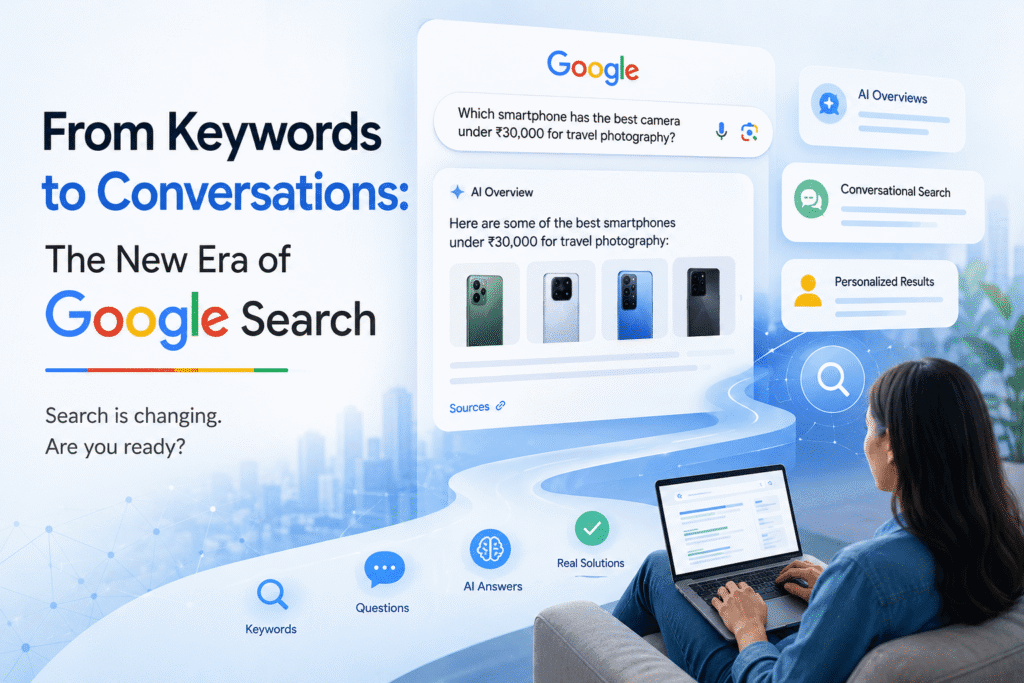
Google’s latest AI announcements have created excitement across the digital marketing world. Every new update, whether it is AI Overviews, conversational search, or smarter recommendations, quickly becomes the center of discussion. But the real story is not just about Google launching new AI tools. The bigger shift is happening in the behavior of users themselves.
People are no longer searching the way they used to.
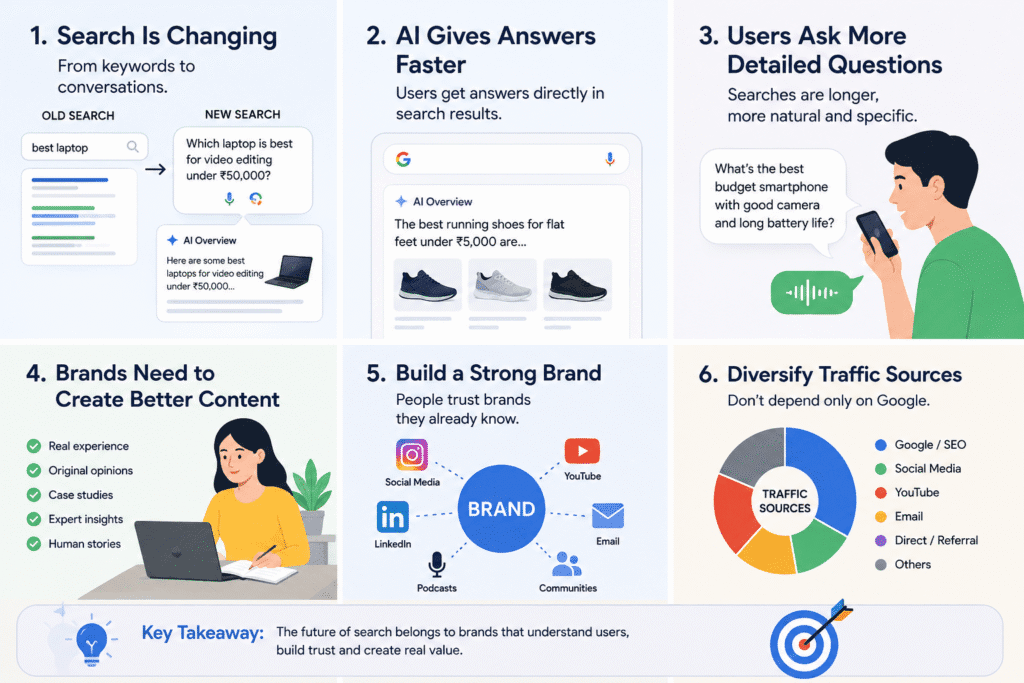
A few years ago, users typed short keywords into Google like “best smartphone” or “cheap hotels.” Today, search has become much more conversational. Users now ask detailed questions such as, “Which smartphone has the best camera under ₹30,000 for travel photography?” or “What is the best hotel in Goa for families near the beach?” Google’s AI-powered systems are designed to understand these longer and more natural searches, and this is changing the entire search experience.
Search is slowly moving away from being a place where users simply find links. Instead, it is becoming a platform where users expect direct answers. With AI-generated summaries and recommendations appearing directly inside search results, people often get the information they need without even clicking on a website.
This creates a major challenge for businesses, publishers, bloggers, and marketers who depend heavily on organic traffic from Google. Informational content that once generated thousands of clicks can now be summarized instantly by AI. As a result, many websites may start seeing lower traffic even if their content is still ranking on Google.
However, this shift does not mean SEO is dead. It simply means businesses need to adapt to a new kind of search environment.
The biggest mistake brands can make right now is continuing to create generic content. AI can easily rewrite simple “Top 10” articles or basic informational blogs. What AI cannot easily replace is real human experience, original opinions, and authentic storytelling. This is why brands should now focus more on creating experience-based content rather than purely keyword-focused articles.
For example, instead of writing an article titled “Best Running Shoes,” a stronger approach would be writing something like, “I Tested 7 Running Shoes for 45 Days. Here’s What Actually Worked.” Content that includes personal experience, case studies, real customer stories, or practical testing naturally becomes more valuable in the AI era because it offers something unique.
At the same time, building a strong brand is becoming more important than ever before. In the past, many businesses relied almost entirely on Google rankings for visibility. But today, brands that already have trust and recognition have a clear advantage. Users are more likely to search directly for brands they know rather than generic terms. This means businesses should invest not only in SEO but also in platforms like Instagram, YouTube, LinkedIn, email marketing, and influencer collaborations to build stronger brand recall.
Another major change is the rise of conversational search. Content now needs to answer real user questions in a natural and simple way. Instead of stuffing pages with keywords, brands should focus on solving problems clearly. Articles should feel helpful and human, not robotic or overly optimized.
Google is also placing greater importance on trust and authority. Websites that provide original research, expert insights, updated information, and credible sources are more likely to stay relevant in AI-powered search results. Businesses that simply copy existing information without adding value may struggle to maintain visibility in the future.
The smartest solution for brands today is diversification. Relying only on Google traffic is becoming risky. Businesses should build communities, email lists, social media audiences, and direct customer relationships. The brands that succeed in the coming years will not be the ones chasing every algorithm update. They will be the ones building trust across multiple platforms.
Google’s AI announcements may feel like the biggest story right now, but the real transformation is happening in user behavior. Search users are becoming more conversational, more specific, and more impatient for instant answers. Businesses that understand this shift early and adapt their content strategy accordingly will have a major advantage in the future of digital marketing.